

How to count days between two dates
Subtract the earlier calendar date from the later one to get elapsed days. If you want to count both the first and last dates as calendar days, add one. For example, January 1 to January 10 is 9 elapsed days, or 10 calendar dates when both endpoints are included.
The answer depends on what you mean by “days between.” A trip planner may need the number of nights away; an event schedule may need to count every date on which the event runs. Those are different counts, even when they use the same start and end dates.
Elapsed days and inclusive dates are different
Elapsed days measure the date-to-date interval. The starting date is the zero point: January 1 to January 1 is 0 elapsed days, and January 1 to January 10 is 9.
An inclusive date count counts each calendar date from the start through the end. Count January 1 as day one, then include January 10, and the total is 10 dates. For an inclusive count, add one to the elapsed-day result when both endpoints should count.
Neither convention is universally right. Use the one that matches the question. A hotel stay from January 1 through January 10 is usually described as 9 nights. A program scheduled to run on every date from January 1 through January 10 covers 10 calendar dates.
How to calculate the difference
- Choose the earlier date as the start and the later date as the end.
- Subtract the start date from the end dateA calendar calculator handles month lengths and leap days for you.
- Decide whether you need elapsed days or an inclusive countAdd one only when the task counts both endpoint dates.
For a quick result, enter the dates in ByteDip’s Date Difference Calculator.
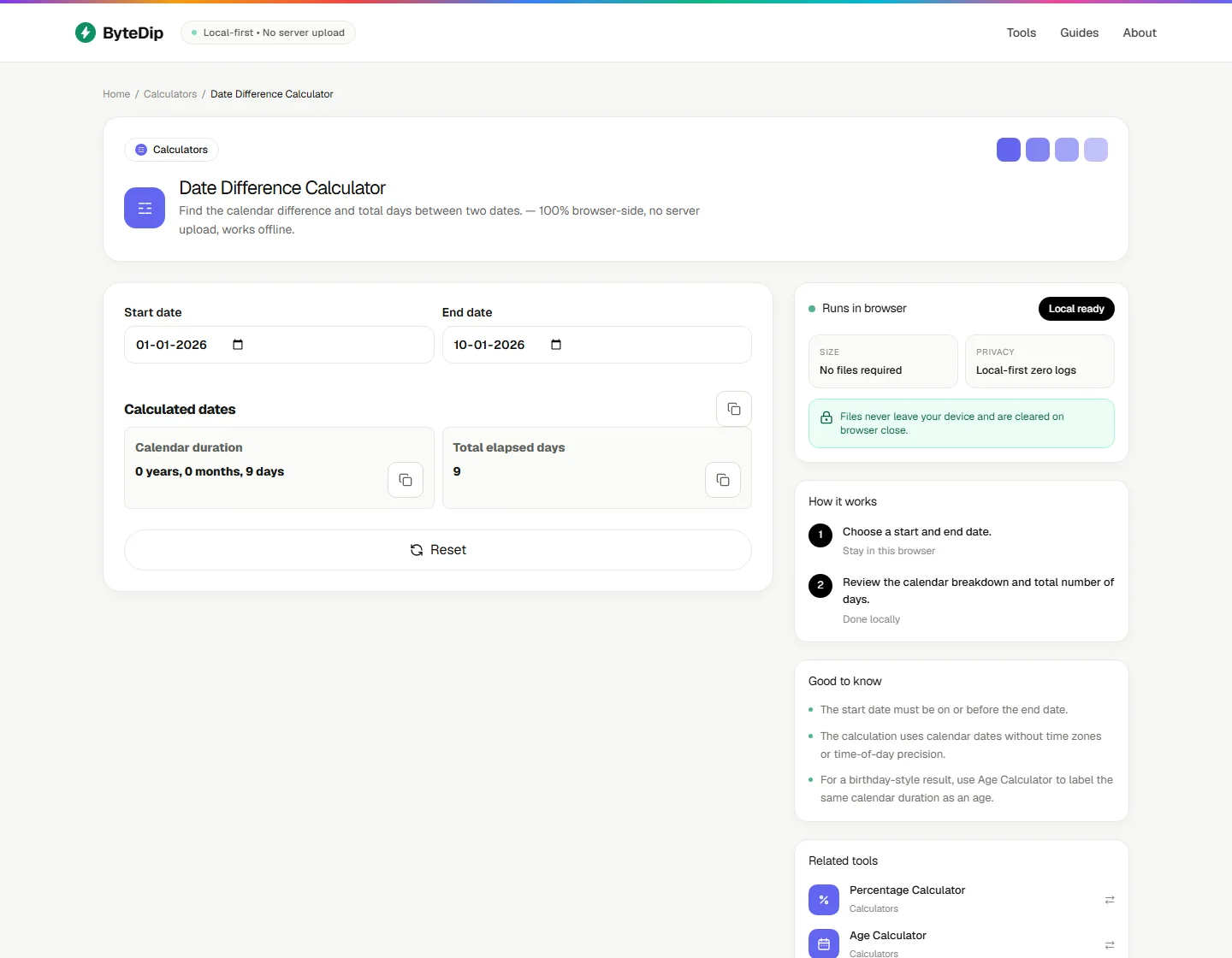
It shows a calendar breakdown in years, months, and days, along with total elapsed days. For example, January 1, 2026 to January 10, 2026 gives 0 years, 0 months, 9 days and 9 total elapsed days. To count both dates inclusively, add one to get 10 calendar dates.
Why the years, months, and days breakdown may differ from total days
Months have different lengths, so a calendar duration is not a fixed number of days per month. The calculator therefore shows a calendar-style breakdown and a separate total elapsed-day count. Use the total when the question asks for a number of elapsed days; use the calendar breakdown when you need a human-readable interval.
For a birthday-style age result, use ByteDip’s Age Calculator.
It labels a calendar duration as an age.
Limits to keep in mind
- The Date Difference Calculator accepts a start date on or before the end date.
- It compares calendar dates; it does not use a time of day or time zone. It is not a precise hours-between-two-moments calculator.
- It returns elapsed calendar days, not an inclusive count, business days, or a holiday-adjusted workday total.
When exact hours matter, use timestamps with the relevant time zone and account for daylight-saving changes. When workdays matter, check the applicable weekend and holiday calendar separately.
Which count should I use?
Use elapsed days for duration questions such as “How many days until the deadline?” or “How long between these dates?” Use an inclusive count when a rule or schedule explicitly counts both the first and last dates. If the result will be used for a contract, deadline, billing period, or policy, follow that rule’s stated counting convention.